Two Works Selected for "Art Olympia 2026"
 tokushige_seiji
I submitted two works to the international open competition "Art Olympia 2026", and both were selected.
The two works I submitted are a pencil drawing and an oil painting. They differ greatly in technique and theme, but both connect to themes I have long been thinking about: "seeing", "boundaries", and "the individual and the whole".
One was born from a bodily sensation of early childhood.
The other considers boundaries, from those between materials to the relationships between people.
Here I would like to introduce the thinking behind each of the two selected works.
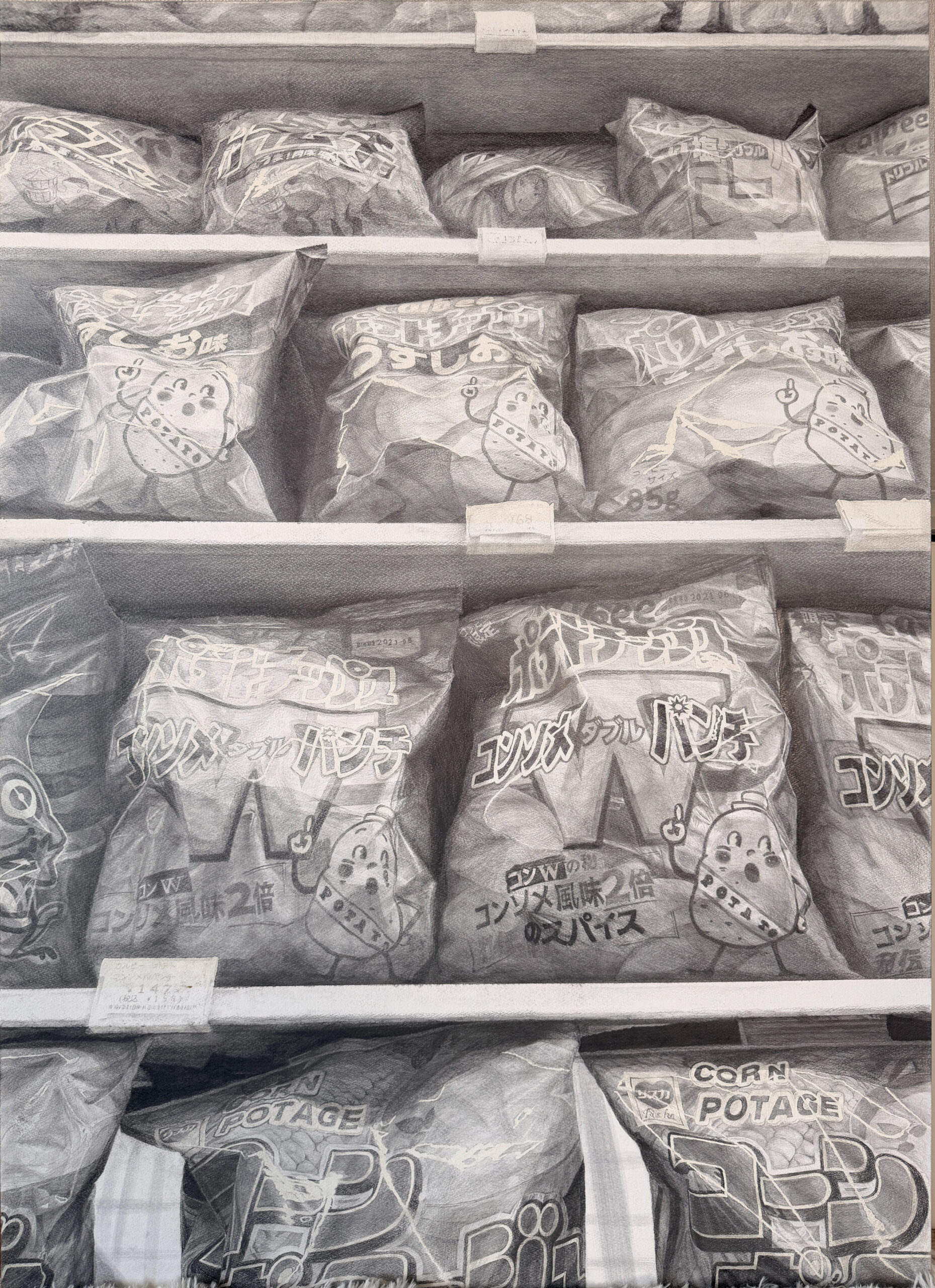
"The View from 100 cm"
B1 (728 mm × 1030 mm) / pencil
"The View from 100 cm" is based on my memory of a sweets aisle as I saw it when I was not yet 100 cm tall.
As a child, when I looked up at the products lined up in the sweets aisle, everything had been arranged for the eye level of adults. What a child's eye could see was not the packaging itself, but the bottoms of the boxes and the undersides of the shelves. A place adults could take in at a casual glance appeared to a child as an entirely different world.
There was the excitement of having the products right in front of me, and at the same time the frustration of "wanting to see, but not being able to".
In this work, I fixed that memory on the picture plane as an extreme upward-looking composition.
I deliberately used only pencil to remove the "colour" that products use to attract people, and to bring out the invisible boundary that exists there: "height".
As I worked, I also noticed something.
The museum, too, is basically designed around the height of an adult body.
Children cannot stand squarely in front of a work, and sometimes end up looking up at it from below at an angle.
"The View from 100 cm" is not simply a work depicting a childhood memory.
It is a work that considers the act of "seeing" itself, which changes with the size of the human body.
"A-wa-i"
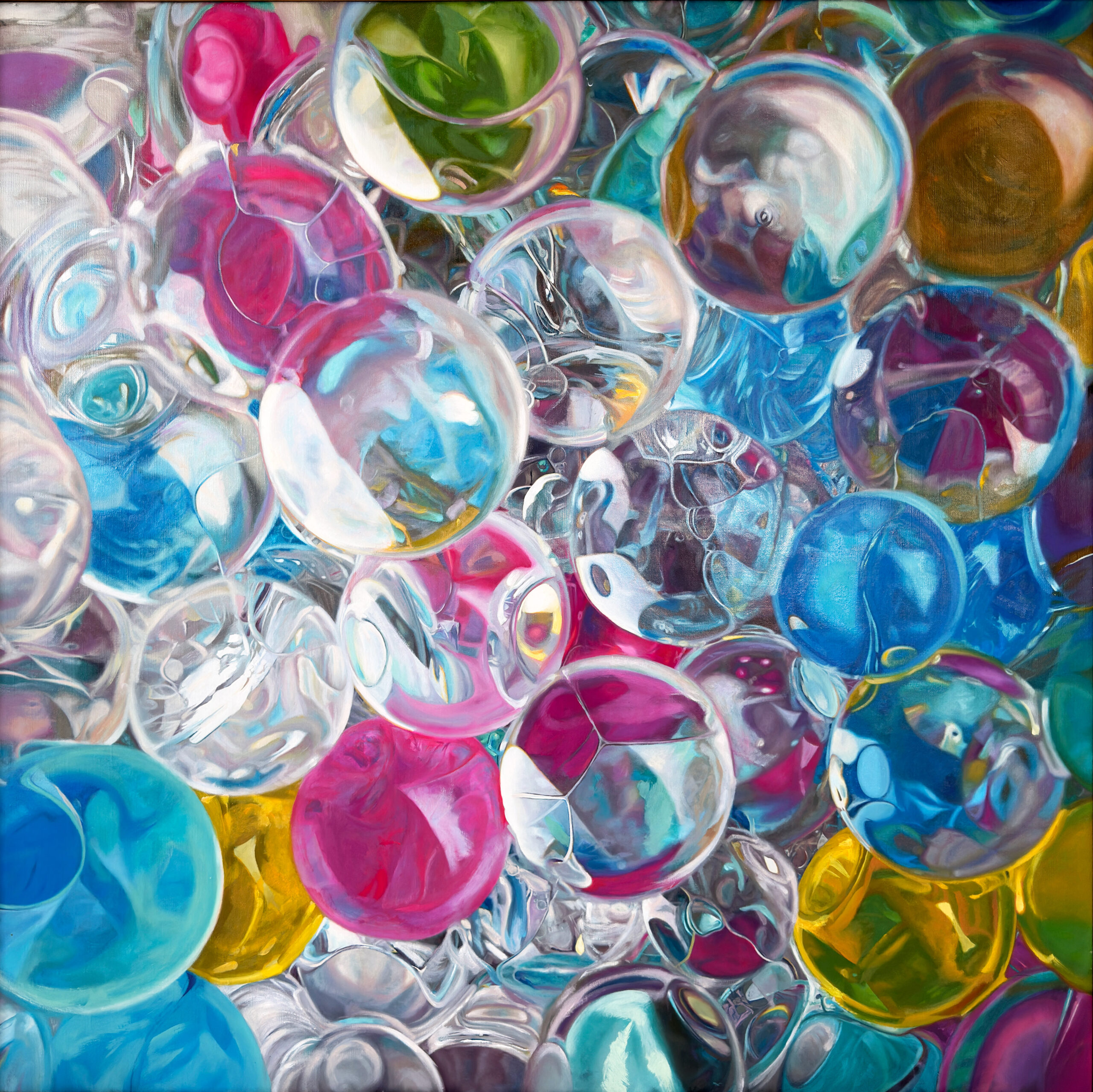
S50 (1167 mm × 1167 mm) / oil
The other selected work is "A-wa-i", an oil painting. "Awai" is a Japanese word for the in-between space where two things meet.
When one thing touches another, where exactly is the boundary between them?
We usually perceive things, and people, as separate existences. But as we shift our viewpoint down to the level of molecules, atoms and then elementary particles, the boundary of "this far is me, and from here on is the other" gradually becomes ambiguous.
"A-wa-i" depicts that ambiguous boundary in oil, as a scene of transparent spheres crowded together.
On the canvas, the spheres touch as they push against one another, and at the points of contact the boundaries seem to melt together. Letting light pass through, reflecting and resonating with one another, they form one large space that could not arise from any single sphere on its own.
Choosing a square support is also related to the idea of this work.
A square has no direction that favours either height or width. Without a hierarchy of top, bottom, left and right, and without fixing a centre or a particular direction, it allows a structure in which space seems to extend beyond the edges of the picture.
There, each sphere keeps its own unique radiance while at the same time being part of the whole.
The individual and the whole are not necessarily opposed.
The whole exists because each individual has its own uniqueness, and because the whole exists, each individual in turn has meaning.
I overlay this relationship onto the relationships between people, and between people and things.
Not cutting boundaries sharply apart, but accepting the ambiguous "awai" between us. Building relationships and creating harmony within that "awai".
I expressed this sensibility, which lives in me as someone raised in Japan, through the state of "transparency".
In an age of repeated division and line-drawing, ambiguous boundaries are not necessarily unstable.
Rather, might accepting that ambiguity be the starting point for different things to coexist?
"A-wa-i" quietly poses that question.
From two different works toward the work ahead
The two selected works, "The View from 100 cm" and "A-wa-i", differ greatly both in method and in the impression they give.
In "The View from 100 cm", starting from a bodily sensation of childhood, I considered the act of "seeing" and the differences in view created by the human body.
In "A-wa-i", on the other hand, I began with the boundaries of matter and expanded my thinking to the individual and the whole, and to the relationships between people.
Yet beneath both lies a shared wish: to look again, from another viewpoint, at the world we usually see without a second thought.
Taking the selection of both works as a milestone, I will continue to make paintings that question "seeing" itself, without being bound by established ways of looking.
When you look at my works, I would be glad if you paid attention not only to what is depicted, but also to "why it looks this way" and "what this work is trying to show".